Tuesday, July 24, 2012

Magazine Advertising

          While I was over in Ireland, I made sure to purchase a magazine, not only for entertainment purposes for the long flight, but to also see if I could get a feel for how the Irish advertise and see how they are similar or different to how the U.S. advertises. The magazine I purchased in Ireland was a sports magazine about Emerald Rugby, and the U.S. magazine I used to compare it with was an American sports magazine, Sports Illustrated. It just so happened that both of these magazines were celebrating the championships of two teams. Pictures of the magazines are below:


Irish Advertisements


Each of these three advertisements came from the Emerald Rugby Magazine. They all carry the same values of standing out and being above the competition. The first ad is from Heineken and can be found on the back cover of the magazine. It says "back to back success"" with two beers back to back. It is obviously talking about the Leinster team for their back to back success in championships, but the double entendre makes Heineken seem like the best choice. It values success above its competition. The second ad is similar when it comes to values as "the best". As one can see in the big print, it says that Bus Eireann is "Ireland's Biggest", hinting to consumers that it's better than all of the rest in size, customer base, and overall success. Its values include success, standing out, and being the better and bigger business in the market. The third ad is for a Tommy Hilfiger wristwatch. It say almost nothing in the ad, but from the picture you can sense a cool type of style that is desirable to men who want to look good while wearing a watch. Being a masculine culture, it is easy to see the masculinity in these ads. They are all promoting the biggest and the best and top notch of the business and their products. The low UAI is also seen in each of these because there's not to much information or explanation going on in the ads. There's no need for fact or reasoning to back up the opinions, the Irish culture tends to embrace it.  Hofstede's other dimension of cultural individuality is also present in the ads, for they each try to separate themselves from the competition. Heineken is the best in success, Bus Eireann is the biggest in Ireland, and Tommy Hilfiger is the best looking and most stylish out of all other designers. They actually are all very similar to the U.S. ads as you will come to find out shortly.

U.S. Advertisements


 These three ads are from the Sports Illustrated Bruins Stanley Cup Championship Edition. Each have similar elements to those of the Irish, seeing as though Ireland and the U.S. do share some cultural similarities. The first ad is for John Hancock Insurance. It is portraying the values of a championship. "sweat, blood, tears, and champagne". All elements of winning and being the best. It is a congratulatory advertisement to the Boston Bruins, however, by expressing the affiliation with the world champion team, the insurance company is connected with top notch success and being the best of the best, or at least partners with them. It is success by association. The second ad is for Geico insurance. It is also advertising based on sports. This one is about golf. Having a perfect swing is hard to do, but getting good insurance isn't. The speed and quality you can get insurance is what's being advertised. great quality that can help you shows Geico being better than something that is difficult, such as signing up with other companies. The values in this ad are superiority and quality assurance. The third ad is from Reebok. Much like the first ad, it is making an affiliation in a congratulatory ad. The affiliation gains Reebok the credibility of success being a sponsor, therefore them and their product is superior to others. Each ad shows off the Hofstede dimensions as well. The U.S. scores as individualist on the IDV category, meaning people don't tend to collectively identify with others outside of immediate family (however it can be different in some situations). This being said, in each ad, one can see that each company separates itself form the competition. there's no collectivism going on. In the MAS category, the U.S. is masculine much like Ireland. This can be seen in the advertisements through it's "blood sweat and tears" and their attributes pertaining to being better than the competition. Like Ireland, the U.S. also has low UAI, so they don't need to much explanation or reasoning behind what they are presented with. They will embrace it for what it is. The last thing I would like to discuss in the Hofstede Dimensions for the U.S. is long-term/ short-term orientation. The U.S. has short- term orientation and this can be seen specifically in the Geico ad when it says it only takes 15 minutes to save on the car insurance. Doing it now rather than later is a perfect example for short-term orientation.

The reason I believe these magazines are so similar are not only because they are both sports magazines and will be read mostly by males of the same market group, but the fact that both countries are very similar in terms of Hofstede's cultural dimensions. The same cultural values and personalities can easily explain why the ads are virtually very similar.

China Advertisement

I am going to also throw China in on this to make the advertising spectrum a little more diverse. This is a Chinese advertisement is for the Beijing Olympics back in 2002. There are a few connections that I can make with this based upon the Hofstede dimensions. The first connection I can make is with is the MAS category. China scores a 66 in this, meaning they focus on masculinity in their advertisements. This can be found in this advertisement with all of the athletes on the pages. They are the best of the best, and even though I can't read what's on the ad, I know it is about watching the Olympics and seeing all of the world's finest athletes compete in the world's biggest tradition of excellence. The next category is UAI. Like Ireland and the U.S., China also has a low UAI, therefore there is no need for too much information on the ads to explain what is going on or what the product being sold is. In this case, the consumers will see the ad and embrace the idea of watching the Olympics, a fine and traditional competition. The only connection I can make with LTO, which China is very high in, is that the glory in victory that China may get from the Olympics is certainly long term for the Chinese and their pride. Therefore, this ad presents a feeling of glory that comes along with the Olympics and the Chinese will want to keep that with them for the long run.

Sunday, July 22, 2012

Analyzing Irish Advertisements - Hofstede Dimensions

          For each of the following advertisements, I have connected one to each of the different Hofstede dimensions. All of these advertisements were found while traveling in Ireland, and I must say, it was an excellent experience to see the similarities and differences we have in advertising (but that's a whole other discussion).

Power Distance (PDI) - 28


With a very low score on the PDI scale, Ireland is seen as a low power distance culture. This means there is no real hierarchical distance between the people of Ireland in the culture. Everyone treats each other as equals for the most part. Elders or the wealthy aren't held to a higher regard as would a high PDI culture. I believe that this advertisement which is found at the Jameson Distillery in Dublin shows this relationship well because in the ad we see that Jameson Whiskey has stated that "most people", meaning common people, prefer their whiskey. It's the average person who enjoys the consumption, therefore everyone in the culture can connect with it and automatically identify. The fact that the average people like it shows that there is no real distinction being made, it's not meant for the rich or the poor, the young or the old; it's simply meant for everyone. This is a perfect example of a low PDI culture.


Individualism/Collectivism (IDV) -70

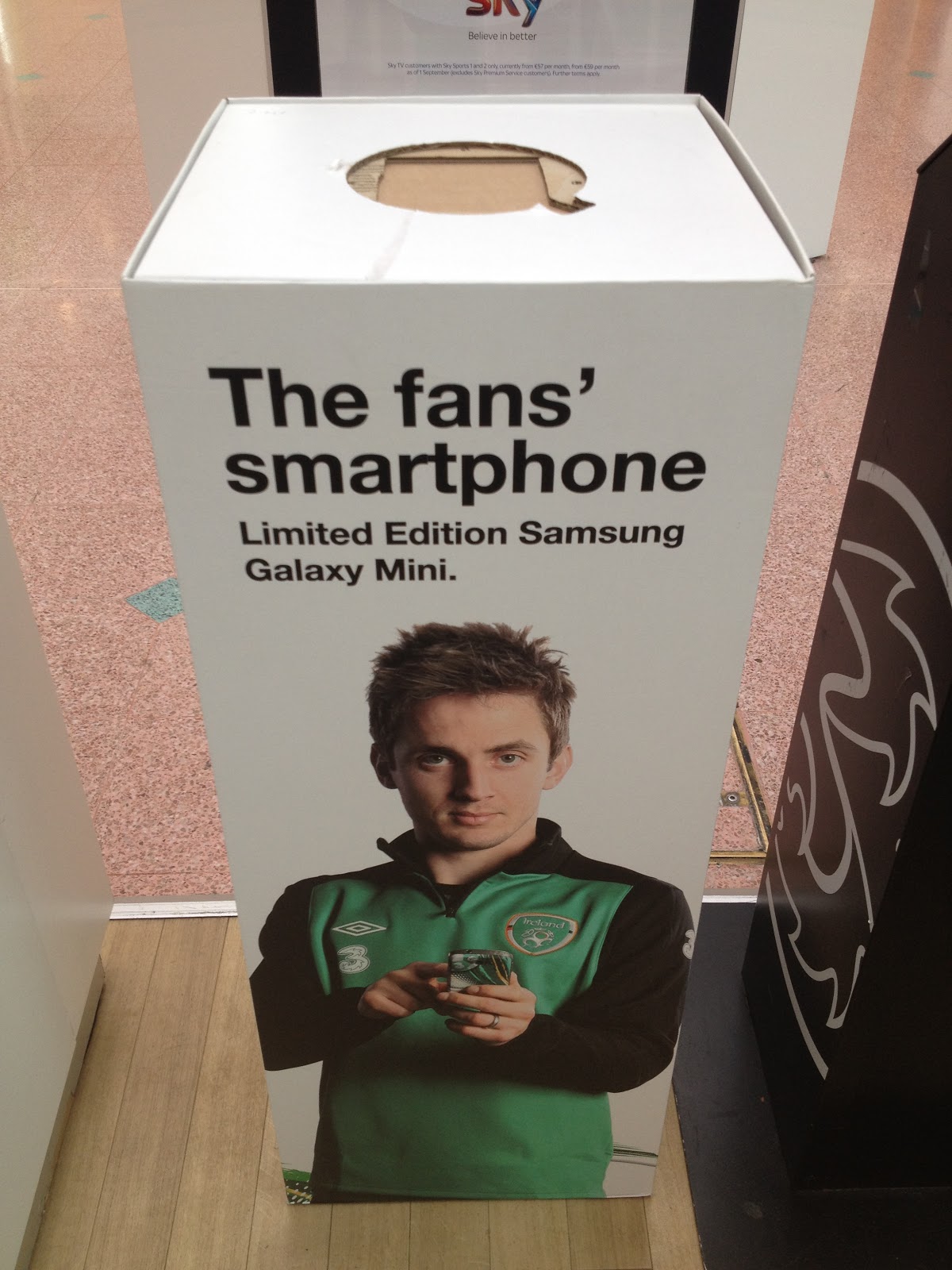
Ireland's IDV score comes in at a 70, meaning it is an individualistic society. There is a common conception of people looking after themselves and their immediate family only with individualistic societies. There is no need to feel a sense of belonging to a group or identify with others outside of their immediate family. When looking at this advertisement I saw in a mall, you can see why it may be a bit confusing, based on this advertisement for the Samsung Galaxy phone, that Ireland is highly individualistic. The ad identifies a group of people that would identify themselves with one another: the "fans", most likely of soccer or Rugby (I can't quite make out the jersey and I'm not too familiar with their sports, but you can tell it's a sports team). This identification being made in the advertisement seems to go against what Hofstede's dimensions tells us about Ireland. Then again, there's always different methods of marketing and advertising that may not always agree with the limits of certain textbook assumptions. While Ireland may be mostly individualistic, which for the most part is true in the culture, there is certainly an identification with groups, especially when it comes to sports teams and Ireland's pride and loyalty to their teams.


Masculinity/Femininity (MAS) - 68

Ireland has a masculinity/femininity score of 68, which means it is a masculine culture. In advertising, a masculine culture will have advertisements that are making its product seem like it is showing off for the most part. It will boast things such as being the biggest, the best, the boldest, the one in control. When looking around the Guinness Brewery, I found these advertisements which perfectly fit the mold of Ireland's masculine identity. Guinness is "grand", "number one", "a league of its own". These advertisements show how Guinness is identifying with the masculine tendencies of being the best or the biggest. Showing off does get the attention of the consumers in the culture. These advertisements do confirm the findings of a masculine culture.

Uncertainty Avoidance (UAI) - 35


The score of 35 puts Ireland at low uncertainty avoidance, meaning they embrace difference or change easily. They do not need all of the facts or to seek out the resources or evidence to support an answer or reason. They can "go with the flow" so to say. With this billboard I saw while riding in a taxi in Dublin, I at first had to take a picture for its strangeness. But then as I was looking for an ad that could incorporate the low UAI culture, it works great. In this ad you can see a man about to reveal something. It turns out the ad is for Ladbrokes, a gambling business. However with not much information, it is uncertain at first what it is. A high uncertainty avoidance culture would not identify with this ad because they need information or explanation to fully identify with something. In Ireland and other low uncertainty avoidance cultures, they can enjoy and identify with the ad simply because it is interesting and offers an invite to the business, no matter how different it may seem. They aren't going to dent something attention because it doesn't offer an explanation or resources. This ad is a great example in showing how Ireland in low UAI in advertising, as well as culture.

Long-term Orientation (LTO) - 43

For  Long-term/short-term orientation, I chose the advertisement on a Kit Kat bar that I saw in Dublin at one of the local convenience stores (don't worry I didn't buy it, though I was tempted). At first I just took the picture because I was interested in the small difference in design they have from the U.S., but as this assignment cam about, there was perfect use for it. In the LTO dimension, Ireland scores a 43, meaning there it is a short-term orientation culture. Short-term orientation has more of the living in the moment mindset. You want to act now or do have something now rather than later as to not waste time or wait until tomorrow. This advertisement telling the consumer they can win instantly shows that short-term orientation that Ireland is part of. This "do it now, have it now"  advertising appeals to the short-term orientation cultures because they are not thinking in terms of longevity or down the road. It is in the moment and ready for the taking. This is a great example of how Ireland has the short-term orientation culture. Who knew a candy bar could teach you something?

Saturday, July 21, 2012

High Value Brands

          After taking a look at Interbrand's website (http://www.interbrand.com/en/best-global-brands/best-global-brands-200 8/best-global-brands-2011.aspx) I got to become familiar with some of the top brands around the world. When looking them over, I was able to make many connections that have been taught throughout class, specifically surrounding Hofstede's Dimensions.
          When a company is successful, that means the consumers have value in what it provides, either a service or product. According to De Mooji, Values are defined as "broad tendencies to prefer a certain state of affairs over others". What Interbrand does is show us, as well as helps consult other companies, the value of the world's top companies. If I were to have first looked at these companies a few months ago, I wouldn't have really thought much about how or why they have been so successfully globally, but now after learning about the many elements in value, I can make those connections. To more fully understand some observations, let's take a few companies for example.
          The first and most successful company I would like to talk about is Coca-Cola. Coca-Cola has been around and on top of the charts for so long because of it's ability to adapt globally to cultural dimensions. Being an American company, you would think that it would only incorporate those principles in their advertising and business strategies. However, what has made them so successful is that they cover many different cultural ranges simply by adapting to the dimensions of that country or group of people. For example, Coca-Cola has recently partnered up with the Olympics in a recent promotion that can reach the more masculine cultures who have value in strength, competition and the likes. To reach a feminine culture, coke gears its advertising strategies towards"Open Happiness" campaign. This campaign focuses on happiness, helping reward consumers, and overall caring; all feminine values. Coke does such a great job at adapting worldwide there is no wonder why it is so successful.
          Another company I can look at comes in at #25 on Interbrand's list: Nike. Nike can adapt to many of its cultural markets simply because it has two ways it can be looked at. Nike has been around as the top sporting goods company for quite some time, delivering quality and top of the line products. People can trust these products and can do so simply due to its history of success. Those with high uncertainty avoidance will be able to connect with Nike because of its ability to stay true to the original basic idea of comfortable quality athletic gear. While they may hold off on trying the newer products, they can always trust the simple, more original styles. Those in low uncertainty avoidance cultures will gladly accept Nike and their new innovative products. They don't mind change and embrace it. The best part about Nike is that the company never truly has changed from its original, there's no dramatic change ever since its establishment. However, there is constant improvement so that both high and low UAI cultures can feel comfortable and accept it.
          As you can see, the Interbrand site does help me understand more with its descriptions and rankings of each of the most successful companies around the world. It is definitely useful to anyone looking to understand or develop what it takes to be a successful business. With the lessons I have learned thus far in the class, I certainly can use it to connect more. Each set of values can be easily understood thanks to its unique site.

Wednesday, July 11, 2012

Value Paradox

          A paradox is a statement that seems contradictory, but in actually is true. Therefore, when we talk about value paradoxes, it is a value that seems like it is contradicting itself in a society, but in reality it is present. It's much like saying we should be healthy because we don't want to be fat, but in reality we will indulge in junk food and we get fat. As de Mooji states in the book Global Marketing and Advertising,
"Value paradoxes reflect the contradictory and meaningful things in life. A value paradox reflects a dilemma. It includes choice, preferring the thing one ought to do over what one wants to do or the other way around. Value paradoxes reflect people's motives and include the elements that trigger people's feelings and emotions, and thus they are used in marketing and advertising."
Value paradoxes are different in every culture. It's effectiveness varies in marketing and advertising as the cultural systems change.
          An example of a value paradox that can be found in the U.S. is our value of equality. America values equality and the fair treatment of each other, however, in reality, the gap between the rich and the poor continues to grow wider. There's also the example of the freedom-belonging paradox as mentioned in the book. Americans value very much the ability to be individual and be able to do things independently from others (it's basically what the country was built on), however there is always that sense of need to belong and be included. You get lonely if you don't belong. This is a paradox because there is the need to be separated, but there is also a need for belonging as well.
          One product that I can think of as an example of value paradox in the U.S. (as well as internationally) is Facebook. Facebook and other social media sites are created so that people can express their thoughts and feelings freely to friends, family, and other connections they make on the internet. This value of freedom of speech or expression of individuality is a large part of people's lives today. This value of free expression is a paradox value because, although one may be able to express whatever they want, or so they may think, there is the ability for others to "flag" or report comments, delete pictures, basically one can take down or get rid of something by complaining about it to have it taken down if it is offensive or not appropriate. People can also delete or block people as well, so one can't truly express to everyone. However a lot of these restrictions are used for safety as well, so they're not all bad.
Example of Facebook's specifications for restrictions
          Ireland also has it's fair share of value paradoxes in its advertisements and products as well. Take Guinness for example. The famous slogans for Guinness are based around Guinness being good for you. Now Guinness may in fact have good qualities to it and has traditionally been a common cure for many "ailments", however, the facts may not be as actual as they make it seem. The value of "good for you" is not as present when you think of the effects beer has on the body. Sure every now and then a beer can be nice for you, but if you drink too much, there are lots of calories in the beer so you will gain weight and alcohol can be harmful to the liver and other arts of the body if you abuse it. The paradox behind Guinness is that although it may be "good for health", one has to be careful and responsible with consumption because alcohol can be a harmful thing.
Guinness advertisement from the Guinness brewery in Dublin, Ireland. Expresses the "good for you" value.
          Value paradoxes are present in all cultures. As they spread through different cultures, they will not hold the same meanings or contexts, so one must be careful when looking at the audience and consumers to advertise and market to. As for value paradoxes, there will always be another side to the value that is at hand.

Survey - What am I, a monochrone or polychron?

          I recently took a survey for class that helped me judge whether or not I could be categorized as a monochron or a polychron when it comes to completing tasks and making business decisions. Not only did I not know what these were before taking the survey, but I had no clue there were separate levels of each.
          The survey began by asking questions that one could rate on a scale whether or not they leaned more towards one answer or the other, or even if they felt neutral by rating it in the middle. Once completed answering the questions, which mainly asked about preferences for decision making, how one likes the business setting, how one works with teams, managing styles, etc..., the answers were added up and a score was given. I found out that I had been given a score of 54, meaning I was in the moderately monochronic rage. To my surprise, it was right on point. I'll insert for you the description:
"These individuals demonstrate an organized approach to projects and are committed to their completion on time. They ultimately prioritize the successful completion of projects, and tend to address tasks in an analytical and information-oriented manner. These individuals tend to prefer an isolated and uninterrupted work environment; social interaction has its appropriate time and place. Their significant communications are usually to the point, logical and written. Though group input is an important element in these individuals’ decision-making process, they ultimately rely on personal judgment to make important final decisions."
In my opinion, this description is accurate because I do encapsulate most of these attributes. I do like to be organized when starting projects so that it can come out effective and making sense. I make sure that it is completed on time, if not sooner. I try to analyze everything that needs to be in order to complete a tasks and make sure all of the information I need is there, Whether it be in a research report or a simple task. The only thing that is debatable in this description is when it comes to interruptions and communication. As a visual learner, I like to have others around me to help explain things if I don't immediately understand it, especially if it's a verbal instruction or assignment. I do have to have it written down, but when giving information or directing people, I do not need to have it written down. Once I look at the tasks and understand it, I can communicate verbally just as effectively. Therefore, I do not mind being interrupted when working because usually talking with others and having explanations helps me understand the tasks better and more efficiently complete them. Going off of this, I do like having group input because others do make good points, but when it comes to being a manager, I believe they need to be able to make final decisions based on what is needed and not necessarily what someone else says could help. It is their job to make sure the right things are being done to complete tasks. Yes, group input can make the decisions easier, but it's not always the best one. They have the experience and knowledge to make the right decisions.
          I am very surprised at how accurate this survey was in pinpointing my business style. I think that it is important for people to understand their styles so that they can more effectively and efficiently learn how to work with others, or themselves, to complete tasks, make decisions, and run successful business practices.

Wednesday, June 20, 2012

Hofstede Cultural Dimensions - USA, Ireland, and China

          To give you all a background on what Hofstede's Five Dimensions of National Culture are, it is a model of five dimensions of national culture developed by Geert Hofstede to explain basic value differences. These five dimensions are: power distance, individualism/collectivism, masculinity/femininity, uncertainty avoidance, and long-term orientation. These dimensions distinguish cultures each being rated on a scale from 0-100 ( for 75 countries and regions). "Hofstede's dimenesions are used as independent variables for comparing cross-cultural studies and provide many useful explainations of cross-cultural differences in behavior."  (De Mooji 60). Taking this into consideration, let us use this system to compare and contrast three countries, the United States, Ireland, and China.
           Power distance (PDI) is the extent to which less powerful members of a society accept and expect that power is distributed unequally. It is reflected in the values of both the less powerful as well as more powerful members of society. The ratings on this dimension for Ireland (28) and the United States (40) are low, therefore authority in these nations can have a negative connotation, meaning a focus on equality in rights and opportunity and independence is highly valued. These cultures do not have such a cultural background as say China would, who is rated at an 80, values the respect of elders and has a social distance between individuals. In China, a social status is made clear as so others can show proper respect. In Ireland and the U.S., such a distance does not occur, therefore there is more of a place for competition, especially in markets. There is less of a need of dependence and idealization on an individual. They are raised at a young age to be dependent, thus when brand are created and marketed, there is more of a "we try harder" approach which lends itself to a harder entrance into/staying in a market.
          Individualism/ Collectivism (IDV) is considered "people looking after themselves and their immediate family only. versus people belonging to in-groups that look after them in exchange for loyalty" (De Mooji 62). Nations such as Ireland and the U.S. are rated as more individualistic because there is more of a division between private space and the public domain. In Ireland you see business people at work strictly to do their jobs, but once the are finished with the day, they go off and become whoever they are outside of work, maybe head to the pub or go be with family. The U.S. is much the same. Collectivistic groups, much like China, are different. They prefer to be surrounded all the time by their collective group. This means for example they would rather stay at work to finish something when surrounded by coworkers rather than take the work home and finish it later by themselves.  Individualistic cultures are universalistic cultures and believe that there are universal values that should be shared by all, whereas collectivistic cultures are particularistic and accept that different groups have different values.
          Masculinity/Femininity (MAS) is defined differently for each aspect. The dominant values in a masculine society are achievement and success; the dominant values in a feminine society are caring for others and quality of life. Masculine societies value the importance of performance and achievement, and achievement it must be demonstrated. Feminine societies are more people oriented and strive for the consensus. Ireland, the U.S., and China all come in around the same mid-range score on this, so they are somewhat in both groups, however high. There is always the masculine perception when it comes to competition in creating a brand in business and all three countries do have strong business oriented economies. However, when it comes to the social aspect, there is a platform for personal connection and "small is beautiful". This is why they are more mid-range.
          Uncertainty Avoidance (UAI) is the extent to which people feel threatened by uncertainty and ambiguity and try to avoid thee situations. In nations with a strong uncertainty avoidance, there is a need for rules and formality to structure life. Communication is more formal. Conflict and competition are threatening. High levels of anxiety and tension are released through emotion in speaking with hand gestures, loud speaking, etc. It is the opposite for weak uncertainty avoiders. We can see that all of these countries are again in the mid range, starting in the 30s going up into the 40s. This means they do have weaker uncertainty avoidance. The U.S. is higher due to the fact that they are more prone to the more formal communication with emotion as well as competition. China, who has the lowest rating is certainly more avoiding of situations, and there is a level of threat within all three cultures. However, the U.S. and Ireland are more prone to dealing with these things in a society of less strict rules. There is always a way around them. China on the other hand is very structured in this way.
           Long-Term Orientation (LTO) is the extent of which a society exhibits a pragmatic future-oriented perspective rather than a conventional historic or short-term point of view. China if of course the long-term orientation. They value tradition, however, innovation is more important. There is clearly a sense of perseverance, ordering relationships by status and observing them this way, as well as thrift and having a sense of shame. Short-term is of course the opposite of this. This is where we find Ireland and the U.S. There is personal steadiness and stability, respect for tradition and reciprocation of greetings, and favors and gifts. The pursuit of happiness is more important than peace of mind. A good example of how Ireland fits in here is their roots in tradition. As you travel around Ireland, you see the beautiful landscape preserved with old buildings and stories that have been around for thousands of years. They are much more personal people, always telling stories to one another and being genuinely greetable and nice. The U.S. is much the same. Though there is not too much history being a pretty young nation in terms of world history, there is always sentiment in remembering where we came from in terms of history, ethics, and preservation of these standards.
          There are several more explanations and reasoning behind the placement of these countries on the cultural dimension scale, but these examples can hopefully help shed some light into it's background. The great thing about cultures is that in some dimensions they can vary so deeply, yet in others they are quite similar. Culture can bring many backgrounds together, and just the opposite too!

Saturday, June 2, 2012

Virtual Visits - Coca-Cola USA vs. Ireland

     The assignment given me for this post was to examine how Coca-Cola addresses the standaradization/adaption debate from which was brought about in the textbook we are reading, Global Marketing and Advertising, by Marieke De Mooij. After examining the company and its two websites, the U.S. and Irish ones, I have come to the conclusion that, while similar in aspects of getting the product out to its consumers and raising awareness of the product, the different sites do it in different ways. Not only do they have different designs, but they seem to have taken the different markets into consideration.
     In the textbook, we learn about the different paradoxes found in international business. What works in one place for an organization may not work in another. Coca-Cola has seemed to have figured this idea out in its websites. In the U.S. website, it is not so much focused on pushing the facts and figures out to the consumers. They already know that Coke is a huge player in the beverage market. Its credibility and success is already there and known by Americans. However, when I switch over to the Irish website, not only does it look different in design than the U.S. site, it focuses more on directing attention to its history, its involvement in community, and basically other selling points that will get personal with the consumer to show them that they are the best company product-wise, community-wise, and credibility-wise.
    Whereas both websites make an effort to show community involvement, not just product and company information, the U.S. website has more focus on its expansion and the involvement it has around the world. As I stated before, Americans already know about coke and its reputation doesn't need much selling point. There's no need to layer on information about the company. That fact is actually quite standard around the world. It's a popular and successsful product. However, as standardized as the credibility and name is around the world, coke has to make sure to adapt itself to the other international market. Americans won't have the same buying behavior as, in this case, the Irish. That is why the Irish website spends more focus on not only reinforcing its credibility and why they should become favorable to the consumer, but it makes sure to touch upon their interests as well. For example, there's the eco-friendly section seen on the site as well as things more directly relatable to them.
    The two sites are very standardized in showing that the company is successful, has grown around the world, and gives back, but they are also different whereas relating to a different type of consumer as they do so. Either way, Coca-Cola does a great job in reflecting the ways in which to deal with the paradoxes discussed in the textbook.